Showing posts with label Research. Show all posts

Wednesday, July 10, 2013

The Cost of Research

I've been kind of in the research doldrums. Right before I went to CT I got a lot of bad news regarding research funding. This isn't uncommon, most research proposals, even good ones, don't get funded right away. I'm not going to starve to death or anything like that, I have a TA stipend to live off of for the next two years. The issue is finding money to pay for the research that will ultimately get me my degree. There's costs with travel, lab samples, overhead costs for the university... it kind of goes on and on.

While I've been working to find research money for 3 out of the four projects I want to do, I have been working on a project that doesn't require any money what-so-ever. It's a computer modeling project that uses databases, which are free. I also have access to geographic information systems software at school, which is also something I don't have to pay for. I'm thinking this project is going to take about a year to finalize.

Once the fall semester starts again, I'll get back into grant writing mode, try again with some other agencies, and cross my fingers that the funding gods decide to grace me with some good luck. In the mean time I've been seeking out alternative ways to jump start my research. A friend recently tried out a website for personal donations to fund some field research to look for thought-to-be-extinct Costa Rican frogs. As of today he's made about $200 of his $1200 goal, so it's a start. I decided to try making one for myself. I'm hoping I can get enough to travel to a few museums to get some preliminary data. Here's hoping!


And if this doesn't work, perhaps some bake sales will bring in some much needed revenue...

Tuesday, September 18, 2012

Blue Screen of Death

I'll skip the apology about being absent for the past month.

Yesterday I returned to my desk and was greeted by a big blue screen with scary white writing on my computer. I have no idea what any of this gibberish meant, but nothing good ever comes from the blue screen of death.

I restarted my computer and everything seemed to be fine, I was even able to recover the one sentence I had written in a Word document I had been working on. I have no idea what caused this hiccup, but as far as I can tell everything seems normal. But it sure is scary to come back to your computer, one where you haven't saved any back-ups in a while, and see this:


I have the time to write this post mid-afternoon on a Tuesday because I am currently backing up everything on my computer onto an external hard drive. Yesterday, I backed up my operating system. I've been stupidly lax, even though I've had disasters happen in the past. Many years ago, I lost my entire undergraduate thesis (twice). Rebuilding research, after months of work, is absolutely heartbreaking. And nothing can induce a panic attack in a graduate student quite like the prospect of having months or years of work lost. Gone. In an instant.

So it might be over kill, but I now have weekly back-ups scheduled from now until the end of time.

Saturday, June 2, 2012

Back to Reality

I fully intended to blog about my vacation with my mom, but a lack of reliable internet sort of put a damper on that plan. It is also completely non-academic, and although I have posted about things other than graduate school on this blog, I don't want to make that too much of a habit.

I will say though, vacations are important for maintaining the sanity of a graduate student. We all need breaks, and anyone who tells you any different is a dirty filthy liar. Our trip to Arizona was one of the better vacations I've taken in a long time, and it was nice to finally see the Grand Canyon. It wouldn't be the kind of thing I'd want to do every year; but, sometimes just staring over something so vast and outside of yourself is what you need to bring everything else in reality back into perspective. It's the main reason I miss being close to an ocean, and why I want to see the Pacific some day.

Hance Rapids. Taken with my mobile, so forgive the lousy quality.

But now I'm back to reality. First, I'm going to do the cliche thing and comment on how I can't believe that it is June already. I'm completely unapologetic about this. Summer intercession is almost over, and come Monday there will once again be college students wandering about. This won't change my working environment much, though. Working in my office over the past few weeks has been incredibly boring. No one is around, and by that I mean I sit in my office for 8 hours by myself, only seeing other human beings when I leave to go to the bathroom or get food/coffee. The PiBBS space is a different world when classes aren't in session. Furthermore, I think a lot of other people are traveling, so it is extra dead.

Another dose of reality came recently when I finally got my rejection letter for a big grant I had applied for back in the fall. The big yellow envelope of depression showed up right before I was going to Arizona, so I put off reading its contents until I got back. I finally went over the reviewer comments the other day. I had myself mentally prepared to get ripped to shreds, but it actually wasn't that bad. I agreed with pretty much everything the reviewers had to say, and they will help me write a stronger proposal for the next go around. Three years of support is just too good to not try again. I didn't really expect to get it this time around, they only funded something like 80 proposals with this particular award.

The reviews I got were also mixed. One reviewer rated my entire application as "fair" and provided the most detailed comments and criticisms. The other two rated it as "good" and "excellent". Even I know that my application wasn't "excellent", so I'm going to just go ahead and average everything out and say that I did "good" on my first attempt. Which isn't too shabby. All three reviewers commented that the whole proposal was really well written. The primary complaints were that I didn't elaborate more on my methods and statistics and that I was vague about the broader impacts. It was only a 5 page proposal, so I'm going to have to really try to fit some of these details in and trim up other areas. I'll also have some publications by the time I try again, so that will also boost my application.

The complaints about my broader impacts section kind of threw me, however. Almost all funding agencies now require applicants to explain how they are going to make the world a better place with their research. Kind of like a Miss America pageant for scientists. I thought I had included enough in this section, but clearly not. Apparently they wanted to know how the specific project I was proposing would be relevant to my community (aka NM). I was more broad about how my activities as a scientist were beneficial to my community. Wrong! Looking back on it, I can easily make my project applicable to NM because it is on the role of large carnivores in communities. NM has a lot of issues with wolf populations and managing their larger carnivores, so this should have been a no brainer. But I wasn't sure what they wanted from me and I gave them the "wrong" thing. Next time I'll know better. These sections are becoming more important and less of a kiss-off, and now I know to put more into it.

The next month is going to be all about me tying up loose ends with projects, and thinking about my comprehensive exams. I'm thinking those will happen in the fall, but I'm kind of on the fence about it. We'll see.

Saturday, January 21, 2012

Sick Start to the Semester

Well no sooner did classes begin did I catch a cold. I've been coughing up a lung all week. I've noticed a lot of people around me coughing, so I think there is probably something going around. At first I was worried that it was my allergies (new kitty), but then Matt started having a sore throat and post nasal drip too. I feel pretty confident now that I've been actually sick all week.

Aside from this minor health setback, the first week of school went pretty well. I like my classes so far, although I'm already anxious about Macroecology. We have two assignments, the first being a class project with very little guidance from the instructors. I'm a little nervous trying to work on something with 25 people, but it isn't due until April. The class is already trying to organize itself, and if we can pull it off we'll hopefully finish the semester with a paper we can submit to a journal for publication.

The rest of my classes just seem like they're going to be fun. My working group is also trying to reorganize ourselves to get back to writing our paper. We got an extension, and I've been trying to do more background reading. At the moment I don't feel competent enough to do much writing, but that will come eventually.

Monday, December 5, 2011

Wrapping up the Semester

It's that time of the semester, where I'm in a perpetual state of "just about finished" before the break. I have three class sessions and two assignments left before I am done with Fall 2011. I finished my paper for paleoclimate seminar that is due tomorrow... the other project is for PiBBS and is really poorly defined. This is lack of instruction has made it annoying and difficult to do, and I just don't feel compelled to do it since the instructor didn't take the effort to assign a clear project. I will, of course, do something just to get through this.

It's also that time of the year where it's really hard for me to find the motivation to get through the last bit of the semester. For one thing, it's starting to get colder, and it would just be so easy to stay in bed in the morning. Fluffy blankets and pajamas sound much better than getting on a dirty city bus to go sit in my office. I'm also usually fried by the end of November. This fall has been very busy with submitting fellowship proposals, developing my dissertation research, and taking classes.

Felisa is gone this week to a conference in New Zealand. It's really bad timing. We have a book chapter due NOW, and we haven't even put together a first draft. I'm getting nervous, but there's really only so much I can do. While she's gone I'll continue to write and edit my part, and I'm also trying to figure out a conceptual diagram to include in the chapter. If I have that finished for when she gets back I'll feel confident that I've done all I can.

As I wrap up this semester, I'm thinking about what I'm going to do when I get back from winter break. What are my goals for the spring? By mid January I hope to have a manuscript submitted, so I'll be dealing with the fallout from that project. In all likelihood the paper won't get accepted right away, and so I'll be spending time editing the paper for resubmission at other journals. Not all journals use the same format, some are REALLY different, so the amount of effort will depend on where we send it and what the reviewer comments say.

My committee expects that I will give a department talk on my master's research some time in the spring, so I want to get some preliminary data on some of my research. It will be easier to talk about future research directions if I can make a little headway on some projects between now and then. The projects that will involve going to museum collections or doing field work will obviously not be something I can talk too much about, but I have some data from databases I can play with in the mean time.

I'm really eager to get home to Connecticut. I miss everyone so much, and it's always too long between visits. I'm excited that we're getting a tree this year, we haven't had one in 4 years. I get anxious when I don't see my family for long stints, especially with my grandmother not doing so great. I think if I manage to not get sick this year, it's going to be a really nice Christmas. Last year was awful, I picked up a stomach flu right after the holiday and Matt and I were sick for most of the break.

The big thing I am looking forward to when I get back in January is the kitty Matt and I adopted. He will finally be coming home with us. We went to PetCo last week and we found such a wonderful cat, we adopted him even though the timing isn't right. Luckily, his foster mommy is willing to keep him until we get back from break, so he can stay comfortable at her house. He's so sweet and handsome!

Saturday, November 12, 2011

The Absolute Longest Couple of Weeks

It's that dreaded time of the fall semester. That time when just about everything seems to be coalescing. Conferences, applications, class assignments, exams, etc. etc. I fared pretty well myself over the past few weeks, at the very least I don't have exams, nor am I doing any grading. For that, at least, I'm thankful.

Last week I was away at a conference, however, during the past three weeks I was also working on a fellowship proposal. This was one of the few conferences where I actually got work done; when I wasn't at a talk or a meeting, I was holed up in my room writing. I just applied for a STAR fellowship through the environmental protection agency. The EPA STAR grants provide up to three years of tuition and stipend support as well as $5,000 a year for research. I'm hoping to get this fellowship for when my current funding ends, otherwise it's back to teaching and grading to support myself and looking for research money elsewhere.

The application had many parts to it, including a five page research proposal, a personal statement, my resume, and three letters of recommendation. I feel pretty good about how the whole application turned out, and I think it's pretty strong for a first submission. We'll see if others agree with me, I guess. Many of my friends are also going through the hell of grant writing. It's just that time of the year: mid fall, everything is due. Several friends were writing NSF predoctoral grants (which, sadly, I'm not eligible for because I have a master's degree) and a few were writing a doctoral dissertation improvement grant (DDIG), which is strictly for research money, not stipends or tuition.

After getting through the past few weeks, I'm finding myself extra agitated at the people you hear going around talking about how scientists are scammers, out to get rich off of research money. Rick Perry comes to mind especially, and after all the work and thought I put into just trying to get a piddly amount of money to stay fed and do work, I really would love to punch people like him in the face. These people are liars, ignorant, or some sad combination of the two. I'm certainly struggling to find research money, as is everyone else I know, and I'm certainly not living it up in my little apartment near the war zone of Albuquerque. I suppose maybe the implication is that scientists shouldn't get paid to do research, or that research expenses should come out of my pocket somehow. But research is a real job, and it would be like asking a teacher to pay for textbooks or a McDonald's worker to pay for the fryer. Ridiculous. Incidentally, many teachers DO pay out of their own money for supplies, which like I said, is ridiculous.

After next week I'll have more time for getting some writing done. I have a class presentation on Tuesday in my paleoclimate seminar, and a lab group presentation on Wednesday. I'm going to be talking about past climate change, and changes in wild fire frequency and vegetation. I have no idea what I'm going to present to my lab though, probably what my new project ideas are for the upcoming year. I don't have data, but I have lots of interesting questions that I want to start working on. I came back from SVP with lots to think about.

Friday, August 12, 2011

Get Back to Work!

Over the past couple weeks I have been getting back into work mode. I did pretty good this week getting in at a reasonable time and staying all day in my office working on various odds and ends. School is starting back up in a week, I can hardly believe I'm going to be starting my second year at UNM so soon. If I was going to be teaching again I'm pretty sure I'd be having major anxiety over it, I'd be in a horrible mood. But, I'm actually feeling a little better than I was last week. I'm excited about the upcoming semester, I'm looking forward to getting a lot of my own work done.

This past week I've pretty much been working on trying to find out as much as I can about fossil sites in New Mexico caves. It's been very productive, so I just stuck with that all week. It's now Friday and I feel pretty confident that I have all of the faunas I'm interested in on my computer in a fairly simple spreadsheet. It only took about a day of messing around with the Neotoma Database and about a day and a half of tedious copying from tables in books to get it all together. I have just over a 1000 entries in my new data sheet, now it's just a matter of looking at what I have.

I haven't seen Felisa much this summer. We were at the mammal meeting together back in June, and I've seen her a handful of times around the department. It'll be good to get back to having weekly meetings to see where I'm at with research, and to finally see what we should do next with our book chapter. A couple weeks ago I put together three chapter sections with associated questions which we should address. I think if I had my way I would have us split up the topics and do some literature reviews to see what questions we could address.

I also downloaded some new carnivore data. The original set I had before got messed up, but I think I figured out what went wrong. I briefly looked at the new stuff and it looks like I avoided the problem I had before; however, I can't get fine time bins like I was hoping I could. I'm coming to the conclusion that a lot of stuff really hasn't been dated well, which makes it really difficult to do certain kinds of projects. I can understand, dates are really expensive. I know that when I do my next excavation, I'm going to definitely write some grants for a lot of radiocarbon dates.

Wednesday, June 22, 2011

Writing Project

I need to start taking advantage of good things that come my way. Starting now.

Felisa was asked to write a chapter for a book, and the other day she invited me to help her with it. We met yesterday to discuss what we were going to do, but what I mostly got out of the conversation is that she thought it would be fun/enjoyable/a good idea to include me. She generally hates writing book chapters, but seems more excited about doing this one. Needless to say, I was surprised and pleased.

The book is about paleoecology for modern ecologists and conservationists. We haven't completely settled on what our chapter will be about, but Felisa made it clear that this is a collaboration and that I have a pretty hefty say in the matter. So far we've decided, very broadly, that we're including climate change in whatever it is we end up writing about. We've got it sort of narrowed down, but only time and research will reveal what "wants" to get written.

I don't think I'm at liberty to give any more details about the book, other than I'm excited to get started working on it. Future updates will probably just be about how the whole thing is progressing. This new project will give me something else to work on during my self imposed "writing time", which I've been neglecting really badly. Between this and the manuscript, I have a lot to work on over the next few months.

Friday, June 17, 2011

Failure: The Ultimate Self Fulfilling Prophecy

Over the past couple of weeks I've been spending a lot of time working on this one particular data set. After several hours of tinkering, I'd find a new and easier way that I could have performed the task. I went through this frustration for about a week, then realized my original data set didn't have everything I wanted, and it also looked funky for reasons I'm still trying to figure out. These kinds of revelations take a lot out of me, to the point where I even look exhausted. Moping about the building doesn't help, and sometimes I just need to give up on a project for a period of time otherwise I get too discouraged.

I decided I needed to reevaluated my priorities for the near future. I'm giving a talk next Sunday, and I had been neglecting this looming deadline for months. I dropped the new projects I had been hopelessly working on to give some attention to an old friend: my master's research.

Sadly, the project I did for my master's thesis is only slightly closer to being published than it was a year ago, but giving a talk on the topic injected me with a little motivation. I had started putting together an outline for the paper. I got all the way to the results section, but had to stop because I needed to do some more statistical analyses. What I had so far was adequate for my thesis, but not for anything I wanted to send to a journal. I did those analyses over the past couple days, so not only do I feel more secure in giving my talk next weekend, but I can move on through the results section of my manuscript outline and on to the discussion, the meat of the paper.

Thank God I had this productive distraction from what I had been doing. I sometimes get stuck in a rut where something doesn't go right, and the next thing I know I'm stuck in a spiral of failure. Hopefully when I come back to my other projects I'll be fresh and have a different (i.e. better) outlook. Among other reasons, this is why I like having multiple projects going at once. If I had to keep working on the same old thing, even if it wasn't going well, I'd go crazy.

Tuesday, May 3, 2011

I'm So Excited!

I've never looked forward to the end of a semester as much as this one.

This is the last week of classes, next weeks if finals week, and then I can move forward with doing what I want to do for a change. All that stands between me and summer are two papers, a website update, giving a final exam, taking a final exam, and grading. That sounds like a lot, because it is a lot, but I can actually see the light at the end of the tunnel. As of next Wednesday afternoon, I will be free.

So what do I plan on doing with all of my new found time? I'm going to get some work done for a change! That isn't as depressing as some would make it out to be. I'm really looking forward to starting my research projects, and one week from tomorrow I will have that luxury. I also have it on good authority that I won't be teaching next year, I'll have other funding. I get the official word on Friday, but it's pretty much a done deal.

Next fall I'm going to start anew, and do things very differently than I did this year. First of all, no teaching. None. That's 20 hours I get back every week. Second of all, I'm going to take fewer courses, and schedule some research time. There are maybe two classes I'm interested in taking, other than BioBlog and Lab Group, and a seminar. A priority come fall is to schedule regular writing time, hopefully every day. I have data, I've had it for months. It's sad that I haven't been able to do anything with it. That's going to change.

Over the summer I'm going to outline the paper Russ and I are supposedly writing, and I'm going to pester him weekly about it (other than when he's in the field, no sense wasting emails when he can't get them). If I can get the figures done, get an abstract written, and send him an outline with solid topic sentences, that might be enough to get the ball rolling.

For right now, I'm just trilled that I'm almost done with the spring semester. I'm down right giddy about it!

Tuesday, February 22, 2011

DeSantis Visit

As a woman, one can't have too many positive role models. And as a scientist, one can't underestimate the value of networking and building professional relationships. Back on February 9th I hosted a visiting speaker for the interdisciplinary seminar I am taking. The purpose of the course is to get people to come do guest lectures on topics that are interesting and have broad reaching implications across many disciplines. I invited Larisa DeSantis from Vanderbilt University as my guest. She does really cool research, and I had met her earlier in October at the Society of Vertebrate Paleontologists meeting in Pittsburgh. I found in Larisa someone I can model my own career after.

Dr. DeSantis received her PhD in 2009, and took a position as a professor at Vanderbilt immediately afterward. That is highly unusual, and was quite an accomplishment. It's no wonder, however, because she had a very productive graduate career and came into her current position with a staggering number of publications for someone so fresh out of school. She is a shining example of why it is such a good idea to produce papers and do talks as you progress towards a degree.

I can also respect Dr. DeSantis because of the education and science outreach she has done in addition to her research. She has produced several educationally based publications as a result of mentoring teachers in science education. During her visit we talked at length about the importance of educational outreach and communicating science. We also talked at length about what I might be doing for my dissertation, and she offered to help in any way she could. It was just nice to have an optimistic conversation about what I might do for a project, and she was honest and encouraging.

Dr. DeSantis is a paleoecologist, but she uses information gleaned from the fossil record to better understand current ecological processes, particularly those related to climate change. She also uses modern day processes to better understand ecological patterns of the past. She's a good person to know, I hope that other people in my class got as much out of her visit as I did.

Monday, January 17, 2011

Reading and Funding

I have about a month to try to get some money to start up some research.

Felisa sent out several emails about research funding to our lab group, all of which have February deadlines. That means I need to get cracking on putting a project together. I meant to get started on this over my break, like so many other things that just didn't happen due to sickness or whatever. But now there are no more excuses. I have plenty of ideas, but they need to be fleshed out.

This semester is also going to be all about reading. I spent some time yesterday looking up papers for me to read this week, since my teaching obligations don't start until the second week of school. They are on tooth stable isotope analyses for the most part. I also found several that are written by the visiting professor I am hosting in February. I have a general idea of what she does, but I want to be more familiar with it all by the time she gets here. That seems like an important thing to do.

I got up at a reasonable time this morning. The real test will be this week, seeing if I can get myself to stick to my 7am wake up time and get myself in a normal schedule.

Wednesday, November 24, 2010

Death Valley Trip

This past weekend our lab group jam packed two SUVs full of gear and people and headed out to Death Valley to clean up the field site and do some additional data collecting.

I've never been driving through California, Nevada, or Arizona before, so it was cool to get that far out west. I've officially stayed in California now, so I should really update the list of states I've been to as a result of this trip.
Lake Mead, the largest reservoir in the US that forms as a result of the damming of the Colorado River by the Hoover Dam


I drove past the Grand Canyon two times during this trip, but yet I have still not seen it. This is unacceptable.

Our main purpose for this trip was to try to retrieve as much field equipment as possible. That included animal traps, wire, and lost i-buttons. Ian, equipped with a map and metal detector, found a good number of traps, but none of the i-buttons. i-buttons are data recorders that are attached to tagged animals, and you get the data back when you trap the animal again. The obvious flaw with this technique is that animals die or get eaten and you just never see them again. The hope was that we would find some lying on the surface, get some additional data, and also save $20 a pop on each data logger. Sadly, that didn't happen. For some reason, a lot of the rocks in the area were setting off the metal detector, so it was a waste of time using that particular piece of equipment. We checked any coyote scat we saw on the surface for i-buttons, but this also turned up nothing.
A panorama of the field site.

Another shot of the field site, the big bush-like things are mesquites.

The other data we collected were branches and thorns and leaves from mesquite bushes. The project was on how the woodrats in Death Valley survive, and they make their middens in these horrific mesquite bushes that will stab you even if you look at them. I've never held so many thorny branches in my life. The idea was to bring back samples to see how much water the woodrats are getting from these plants. This involved carefully stripping leaves off of the branches, and placing the branches and leaves in separate collection bags. We'll weigh and dry the leaves and branches to see how much water they have back in the lab. I think I still have mesquite spines stuck in my fingers.
An adorable young (and healthy) woodrat that was trapped in our campsite!

The whole trip was enjoyable over all. I got to bond some more with my lab mates, and I find camping to be fun in general anyway. However, Friday evening the wind really picked up and it didn't subside for the rest of the weekend. This made every task much harder, and I'm glad I brought ear plugs. Otherwise, I doubt I would have gotten much sleep with the flapping of our tent. In addition to the wind, there was this raven on our camp site that was awake at the crack of dawn making this horrible "warking" noise. It sounded funny but was annoying Fred.

The view from our campsite.


We (as in the Smith Lab girls) proved ourselves to be giggly and upbeat throughout the weekend. Meghan, Fred, and I crammed ourselves into a tent that was really only intended for two people, and hilarity ensued. The first night Fred and I were in the vehicle that arrived early to set up camp, and we had an early dinner with Ian and Summer before calling it a fairly early night. I had gotten a little sleep when the second car finally arrived, and Meghan had her sleeping pad and bag to get into the tent with us. The sleeping pad was more like a raft, and it was a ridiculous effort at first to try and get it in the tent over me and Fred. We had a pretty good laugh about it. Meghan is officially the happiest most excitable person I know, regardless of what time of day it is.

The afternoon of our last full day was spent in Titus Canyon, scoping out midden locations. It was full of amazing geology and I did a lot of climbing around on rock faces looking for little caves.

A fairly large cave on a rock face in Titus Canyon. There was a huge midden inside, and some bones from something that was roughly sheep sized.

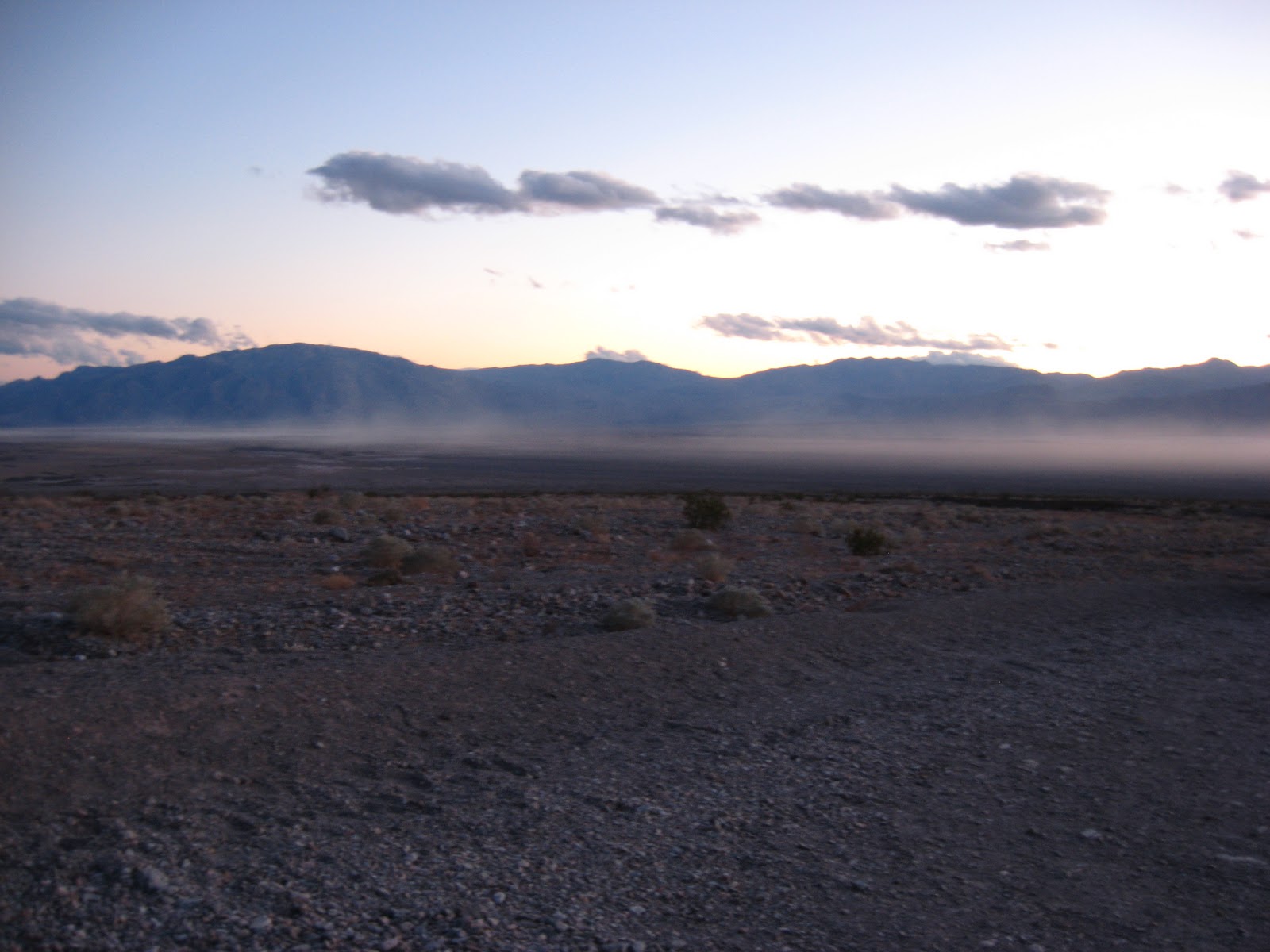
View from the exit of Titus canyon. All that tan stuff is dust being blown around by the wind. The wind didn't let up for a full 48 hours.

I took more pictures, but there are more than I want to put up here. I'll probably put them in an online album to share, where the beauty of Death Valley can be done justice.

Wednesday, November 17, 2010

IMPPS Research Coordinated Network

Before it gets pushed back too far in my memory, I wanted to spend a little time talking about my weekend sitting in with my adviser's research coordinated network (RCN), IMPPS. IMPPS stands for Integrating Macroecological Pattern and Processes across Scales. I could spend an entire post trying to define what exactly that all means, but essentially they are interested in large scale patterns across life that can be described fairly succinctly. Their focus is on body size: how it has changed through time and how physiological constraints on body size have shaped evolution, with an emphasis on mammalian evolution.

I did a lot of intensive listening all weekend which, surprisingly, took a lot out of me. It was interesting to see how a large research group functions, since that is something I have never participated in. The group publishes a lot together, but there are also small sub-projects within the group. I was impressed at how much got done over a few short days. This is a very productive group of scientists.

I can't say for sure if I will be collaborating with them in the future. Their NSF funding is running out, and they only have a few more meetings in the future. I'm also not sure that I am interested in all of the same research questions that they are; but, there are a few. I did a little data mining this weekend for a fairly new project, and if I get sucked into that it could result in something good for me. Felisa said I was welcome to get as involved as I wanted with the group, if it was something I felt I wanted to do. I think the project I was helping with sounded interesting, but I'll need to learn more about it before I get myself invested in it.

In general I like the members of the group. I have some disagreements with some of the opinions that I heard this weekend, but that isn't a bad thing. That's just something that naturally occurs. I don't think I'm going to agree with Felisa or Jim or anyone on everything; that wasn't even the case with Russ. I think it's important that everyone in the group enjoys working together; they are friendly. That makes it possible to actually accomplish things.

On Saturday evening we had a fancy pizza party at Felisa's house. It was make your own pizza: home made dough, interesting toppings, and lots of wine followed by dessert. It was good way to break up the hard work of the weekend. Plus, I can only listen to work related things for so long before I get burnt out.

In conclusion, I would say that it was a generally good experience and I'm glad I went. I also got to hang out with Meghan a lot, and I got to know her better.

Tomorrow the lab group is leaving for Death Valley for a few days. When I return I will give my account of that little adventure.

Tuesday, November 16, 2010

The Importance of Communication

Humans are animals; however, we have several characteristics that make us stand out as unique. Our large brains have allowed us to be able to do some pretty amazing things. Aside from being able to walk upright, solve problems, and be self aware, we also engage in fairly complex relationships. Those relationships are possible because of the complex ways in which we communicate: visually, verbally, and through writing.

I want to talk about science communication. Or rather, the lack there of. Communication is especially bad between scientists and non-scientists. The point of science is to answer questions and produce new information. It's rather ironic, then, that there is such poor communication of scientific ideas. Many scientists seem unwilling to ensure that their research is known and understood.

Before I go on, I know some of my more "sciency" friends might claim that the general public is unwilling to learn, or even listen to what scientists have to say. I agree, but only to a certain extent. I believe this is partially true, because scientists have allowed a stereotype about themselves to perpetuate, to a point where it is coming back to bite us in the butt. That stereotype is: scientists are cold, uncaring, arrogant people who can't be bothered to explain what they do. This is the point of view that exists, and it is largely the fault of scientists who are, in fact - cold, uncaring, arrogant people who can't be bothered to explain what they do to those people who are (in their own minds) too stupid to understand anyway.

Now I ask my fellow sciency people, would you want to LISTEN to a person with that kind of attitude? Of course not! Yet we expect the general public to just listen to us, even when we don't take the time to explain to them what we are up to in a way that is accessible. Then we lose our patience if they can't understand, in spite of the fact that a lot of what we do is confusing. This, my friends, is called a superiority complex. It is based on the false assumption that somehow we are smarter or better than "they" are. And, it is going to make it really difficult to get people to listen to us in the future when we have something really important to say (if you can imagine it being more difficult than it is already).

I know for a fact that a lot of scientists don't write well. I do a lot of reading, that comes with college and graduate school. Scientific papers are dense, in every definition of the word. This isn't always the fault of the author; limitations and requirements imposed by editors and journals often make it impossible to write something pleasant or intelligible to a non-expert. As a result, scientists learn to communicate well with others in their own specific area of interest, but they can't always communicate adequately with outsiders. This is a deficiency, and it poses a huge problem when trying to solve multifaceted problems that require interdisciplinary collaboration. This is compounded when the results of research have political or economic implications.

The simple fact remains: a lot of research funding comes from the government. Ultimately, that money comes from taxes. So in a sense, we are being paid by the general public to do what we do. Therefore, it benefits scientists to effectively communicate; not just with each other, but with everyone.If "they" don't understand what we do, "they" will stop paying us to do it.

We are facing many troubles: environmental, biological, and economical. And the people who can make meaningful policy, laws, and decisions are either not listening to us, or they don't understand. In reality, it's probably a little of both. We can spend a bunch of time and energy going back and forth, arguing about whose fault it is. We can ignore people who are perceived to be too "dumb" to know what's good for them. Or, we can take a proactive approach and commit ourselves to communicating more effectively. I'm not saying that we need to restructure the way in which we publish original research (although, one could argue, that might be a good thing). What I am saying is that scientists need to get outside of their individual bubbles, and interact with regular people. We need to reach out. We need to talk and write in a way that is accessible.

Even if you are a scientist who hates humanity, who thinks people are stupid. You should make an effort to give your wealth of knowledge to someone other than yourself, if only for the sake of getting things done.

Next semester I will be participating in a class that runs a biology blog. It will highlight research as well as other things going on in the department of Biology at UNM, as well as other biology related topics.
Matt and I also have plans for starting a science blog, with the explicit goal of making science accessible to the general public.
My plan is to connect those blogs to my PhD blog in some fashion, with the hopes of increasing outreach.

Wednesday, November 10, 2010

One Year Later

Today was much better, I got a good nights sleep and had a fairly productive day.

As of tomorrow, Nov. 11th, it will have been a year since I defended my master's thesis, and also about a year since I decided that a PhD was a good idea. I still think it is, but I thought I'd have a better handle on what I should be doing. I suppose that since I switched academic fields, it's okay that I'm swamped with classwork to get me up to speed. As far as research goes, I have actually been sorting through some new data to try and answer some new research questions Felisa and I have been discussing. The first step so far has been to see if the data we need even exists already.

Tomorrow evening Meghan and I are heading up to Santa Fe to sit in with the research coordinated network (RCN) that Felisa is a part of. Felisa thought it would be a good opportunity for us to see what it is like working in a large research group, which is something I have no experience with. There is a chance that we could get involved if the group is going to start working on something that interests us. The meeting is from Friday morning till noon on Monday. Meghan and I are only staying through Sunday, since we have teaching and classes to get back to.

If nothing else, I'll get to listen to really smart people talk about research, and probably hang out with my adviser and lab mate more than I have had the chance to so far. And, I have a biostatistics assignment due on Tuesday, and Meghan and I can work together on it easily since we're sharing a room at the meeting.

I'm hoping it will be an educational experience, regardless.

Friday, October 22, 2010

Let's Do Some Research!

I had a (very) brief meeting with my adviser yesterday, but I think I managed to figure out what I want my research topic to be for my dissertation. Now it's just a matter of fleshing it out, which means I'm going to spend lots of time in the near future sitting down and thinking about important questions and how to potentially answer them.

I picked a topic that can hopefully lead down several different research directions. My dissertation needs to be 4 chapters long: 3 should be really good, 1 can stand to be just "okay". There is no requirement that the chapters be related, but I think I would be happier with a piece of work that tells a larger story.

Those of you who have been following my research should know by now of my interest in Pleistocene non-analog faunas. By now it's been pretty well established that they have biological significance. Questions remain, however, as to why they existed. Another way of looking at it is, "Why was there so much more biodiversity then, and where did it go?" One hypothesis is that during the Pleistocene organisms were able to more finely partition ecological niches, which enabled more geographic overlap. This is a fine hypothesis that has not been tested; I intend to. How will I do that? I haven't figured that part out yet, but I'm working on it.

Wednesday, October 20, 2010

Not Teaching Next Year?

I received some intriguing news today: Jim and Marcus have written me into their grant to do GIS work on a project they will hopefully be beginning next fall. It was kind of funny how I found out, because Marcus flat out asked me if Jim had told me: I had only vaguely indicated I was interested in the project. I guess that was enough for them to decide I was "the one" who would do it. I don't know too much about the project, but it involves some time and space analyses with human populations and ecological hot spots. I'll get to learn GIS, and add that to my intellectual tool box. GIS stands for Geographic Information Systems.

I'm not sure if being "written into the grant" means I'll get some funding for working on it, but I sure hope so. If that's the case, perhaps I can cut back on the amount of time I end up teaching during my PhD. Anything to reduce the amount of mindless grading would be nice. I already have a large amount of teaching experience on my CV from this year and from throughout my master's. A little variety would be a good thing. This will be amazing, because GIS is a tool I can use for my own purposes, and it would be nice to get to work on a project with people, especially one that sounds so interesting.

Next step, see if there is an introductory class I can take on GIS this spring to get a jump on next fall.

Tuesday, September 28, 2010

Debut in the Smith-Brown Lab

Good day today. Classes didn't drag too much, I had some interesting moments of intellectual reflection, and I got some work done. Lunch was also amazing, because it was a repeat of the delicious soup that Matt made for dinner last night. I was pleasantly surprised yesterday when I got home, because he had made a big pot of egg lemon soup. I think it might be a new favorite, that man can cook!

I'm currently putting some finishing touches on a talk that I am giving tomorrow: the same talk I'm giving in a few weeks at a conference. Tomorrow, however, I am talking about my previous research to my lab group, which has me a little nervous, but excited as well.

I am one of a couple people in the lab group who regularly thinks about the fossil record. Felisa's advice for tomorrow is to be careful about what I assume, as in, don't assume that people in the lab know terminology, and all there is to know about my research. Odds are, they don't know. This is so true, I've been in the situation where I've been talking to very smart geologists who were clueless. I'm going to guess that biologists will have similar problems. What I study, and how I've been studying it, is very different from what they are probably expecting. Different questions, different data sets, difference data problems, and different analysis problems.

I have to keep reminding myself that this department accepted me for a reason. I have a different background; I think about time differently; and, therefore, I think about biological communities very differently. Not better, differently. And so I hope that makes me valuable.

If nothing else, this will get me warmed up for Pittsburgh in a couple weeks. And it'll let everyone know exactly what I'm about.

Friday, September 24, 2010

Year 1 Week 5 Recap

Finally, it's Friday! Actually, the week went by much faster than I would have liked, so I'm rather shocked that it is already Friday.

This week had a little more variety than usual. Monday was typical, but the lab wasn't ridiculously involved, and I felt it went rather smoothly. We watched a movie on the deep oceans for part of it. Any lab that involves watching a movie narrated by Johnny Depp is bound to be laid back and easy. The hopelessness of my students with the metrics system is also deminishing. I'm a little confused as to why they act like they've never seen this before. Apparently it is a part of their standardized tests, fairly early on in school, if they went to public school (presumably, most of them did). Maybe it's one of those things where you see it when you're young, forget it, and then years later it shows up agian and it's like it is brand new.

A large part of my first year, I have determined, is going to be about collecting tools for my research. This involves making as many connections as possible, and learning as many new tricks as I can. Today I met with a Peter Fawcett in the Earth and Planetary Sciences department (sort of like geosciences). We discussed looking at pollen, and directed me to some other helpful people and reading. I ended up at the library later to obtain some books which will hopefully aid me. It looks like if I'm going to proceed with this project, I'll need to spend some time in another lab in another institution doing my data collection, because UNM doesn't have a lab that works with pollen.

I've also started a file on my computer for reading that I want to do to get caught up in my area of research. This is on top of the other reading I'll need to do for class.

Today my adviser gave a talk over in Earth and Planetary Sciences, which I attended. Her talk was on the after effects of the Late Quaternary Extinction, specifically, the drop in methane at the onset of the Younger Dryas that may have been caused by the loss of large herbivores. The idea is that large herbivores produce a lot of methane, which is an important greenhouse gas. For example, cows produce an absurd amount of methane; one could then imagine that things like mammoths also probably produced a lot of methane. Remove them from the picture, and you have a decrease in methane. If humans were the cause of this extinction, this means that we had a hand in altering the biogeochemistry of the earth WAY before the industrial revolution. If this is true, then humans are indeed the most miserably destructive creatures on the planet.

It's important to quickly note here that I'm sort of the oddball in my research group. I don't necessarily buy into the idea that humans are the sole (or necessarily the major) cause of the megafauna extinction at the end of the last ice age. My research group seems to think so. It's a sexy idea to think that humans caused it, and its really difficult to conclusively invoke climate. At the same time, I think the evidence just doesn't provide enough information to say humans were the main cause. Actually, I'm of the opinion that more evidence is needed to say much of anything regarding it. Until then, we have to just work with what we have without, hopefully, making too many assumptions about what we think we know.

Felisa's talk was interesting for many reasons, the foremost being that it asks a really important question: What did the removal of all the large herbivores do to the climate, environment, etc. once they were gone? Regardless of how it happened, the fact that they were gone likely had major ecological consequences. I agree with her a 100% on that point, and my research is largely involved with trying to figure all this out. The fact remains that a lot of what happened at the end of the Pleistocene, human caused or not, is happening NOW as a result of human activity on this planet. The consequences of those activites is largely unknown, but based upon what happened in the past, maybe we can prepare ourselves or stop it from happening in the first place.